Coastal and canyon geography across San Diego County provides ideal breeding environments for Rattus rattus, commonly known as the roof rat. Neighborhoods with dense subtropical canopies and fruit-bearing trees,…
Coastal and canyon geography across San Diego County provides ideal breeding environments for Rattus rattus, commonly known as the roof rat. Neighborhoods with dense subtropical canopies and fruit-bearing trees, including mature citrus groves in Rancho Bernardo and dense palm lines in Point Loma, Ocean Beach, and Pacific Beach, funnel rodents directly onto ridgelines and eaves. Roof rats navigate telephone cables and overhanging branches, exploiting structural weaknesses such as uncapped Spanish tile weep holes in La Jolla, rotted fascia along Craftsman bungalows in North Park and Hillcrest, and open attic vents across 1960s ranch homes in Clairemont and Mira Mesa. Chemical poison baits placed in attics pose secondary poisoning risks to domestic pets and native raptors, while failing to solve the entry problem; when a poisoned rodent dies inside an inaccessible wall void, severe decomposition odors and fly cycles follow.
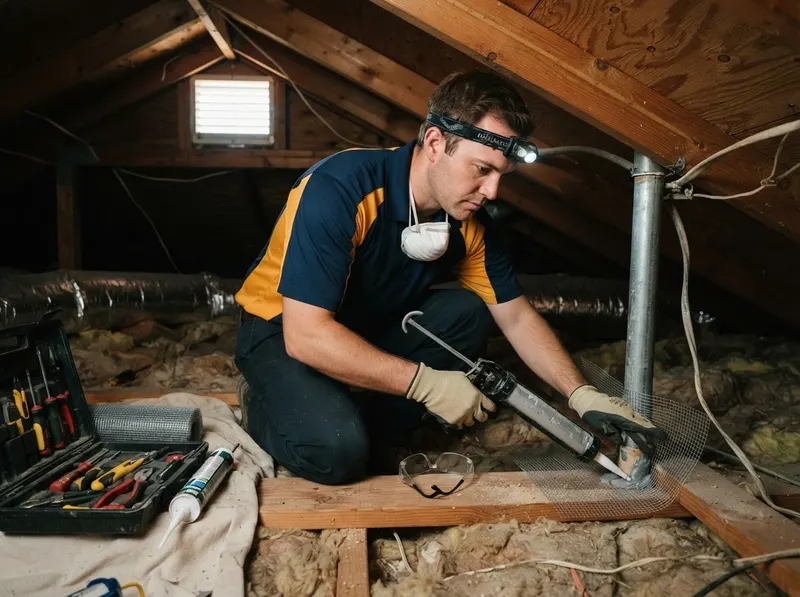
Exclusion serves as the only permanent resolution by converting the entire building envelope into an impenetrable barrier. The structural defense process begins with installing 1/4-inch 19-gauge hot-dipped galvanized hardware cloth behind foundation dormers, gable louvers, and crawl space access panels. Technicians secure metal flashing over chewed wood trim, seal plumbing penetrations with copper mesh and elastomeric compounds, and install custom sheet metal cones around exposed utility risers. In river corridors such as Mission Valley, where Norway rats frequently travel along storm drainage and ground systems, exclusion protocols simultaneously secure crawlspaces and subfloor drain routes alongside upper rooflines.
Decision guidance depends on the current state of structural intrusion. If a property experiences occasional exterior foraging without attic noise, exterior perimeter trapping stations paired with brush clearance of at least 3 feet from the roofline are sufficient. If active scratching occurs above ceilings between dusk and dawn, droppings measure 1/4 to 1/2 inch with pointed ends, or insulation shows compressed travel runs, full structural exclusion is required. The trade-off is mechanical and physical: baiting offers lower upfront friction but guarantees recurring service costs, whereas complete structural exclusion requires higher initial construction labor to terminate rodent migration cycles permanently without binding homeowners to perpetual monthly contracts.
Every job gets a firm, written price after a free on-site visit.
Tell us about your roof rat and rodent attic exclusion job in San Diego and we'll send a clear, written quote, usually the same day.
 PestPilot Pest Control